
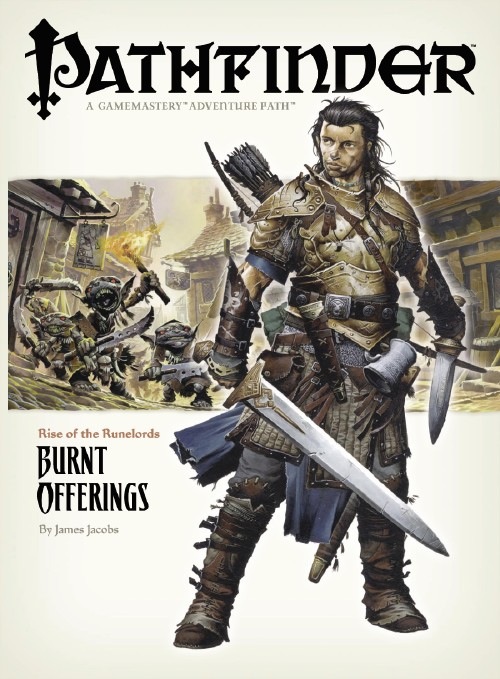
I’m starting my reread of Paizo’s Pathfinder adventures at the very beginning: The Rise of the Runelords Adventure Path. If you’re unfamiliar with the term “Adventure Path”, it’s a kind of published RPG campaign, consisting of a number of linked adventures. Traditionally these go from low to high level but over the last several years Paizo has started to change this up, going from either low to mid level or mid to high. Rise of the Runelords takes players from level 1 to level 18, as they must protect the town of Sandpoint and all of Varisia from threats kicked off by the awakening of the ancient evil wizard Karzoug. The adventures that make up the campaign are operating in a pretty classic mode, mostly set in the wilderness or dungeons, with a brief side trek in a major city. Rise of the Runelords was originally published as six separate adventures, written for 3.5 D&D, but was republished in 2012 in a single volume, with better art, and rules updated to the Pathfinder RPG. I’m looking at the rerelease, as that is the most definitive version of the campaign.
Rise of the Runelords was the first Pathfinder Adventure Path, but it isn’t the first adventure path that Paizo had published. The company first explored the concept of linked adventures during their time publishing Dungeon and Dragon, with The Shackled City, Age of Worms, and Savage Tide adventure paths, running through an entire year of Dungeon issues, taking players from level one to twenty. These Adventure paths were accompanied by supporting articles in both Dungeon and Dragon, exploring both the setting of adventures and offering treasure, monsters and players options that would fit with the adventure path.
Rise of the Runelords is something of a bridge, offering a similar package of an ongoing adventure with support articles, but set in Paizo’s own campaign setting. By publishing under the 3.5 OGL, Paizo was able to continue catering to the readership they had gained as the publisher of the official D&D magazines, but without any support from Wizards of the Coast. Because of this Rise of the Runelords had to serve two purposes, showing that Paizo could still put out fun and challenging adventures without an official connection to D&D, and introducing players and GMs to the new setting.
14 years of continued Pathfinder Adventure Paths and the fact that Paizo was able to pivot to publishing two editions of an official Pathfinder RPG, as well as the science fantasy spinoff game Starfinder (soon to have a second edition of its own) is proof enough that Rise of the Runelords was a commercial success. But how successful is it as a story?
Burnt Offerings
Burnt Offerings kicks off the campaign with a goblin attack on a festival in the town of Sandpoint, which thrusts players into the role of town heroes for their efforts in driving the attacking Goblins away. After a number of short interludes dealing with the aftermath of the attack (which serve to introduce players to Sandpoint and a number of recurring NPCs) the party is confronted with evidence that someone directed the attack. They don’t have to wait long for proof as another Goblin attack strikes town, this time in an abduction and murder at the town Glassworks. While driving off this attack the players discover a series of ruins beneath sandpoint, which point to a plot by a devotee of Lamashtu to destroy Sandpoint. In order to prevent a final brutal attack and rescue the abducted Ameiko Kajitsu the players must attack the goblin stronghold in the ruin of Thistletop. This storyline deftly juggles a bitter family drama, bloody goblin attacks, and dungeon delving while introducing players to ruined legacy of Thassilon which is the throughline of the whole campaign.
This is an excellent introductory adventure, and could easily be run on its own, with no connections to the rest of the campaign. It steadily ramps up the threats that players face, while keeping a strong narrative throughline from start to finish, A goblin attack brings the party together, and all of the major beats of this adventure spin out from that attack, giving the story a degree of focus and cohesion that can be missing from TTRPG adventures. At every turn when there is a chance for a party to become distracted, a fresh goblin attack and the search for the organizing force behind them draws players back to the main story. Later adventures in this campaign never quite reach this level of cohesion, making this chapter especially memorable.
This focus doesn’t prevent the chapter from taking pains to introduce a number of setting elements that are key to the rest of the campaign. First and foremost Burnt Offerings serves as a chance to introduce and endear players to Sandpoint. Between the encounters included in the aftermath of the initial attack and a highly detailed sketch of the town and important NPCs a gamemaster will have no problems making Sandpoint feel alive. Among the NPCs introduced here are several who will return in future chapters, or even in later Adventure Paths. I especially appreciate that it gives a narrative function to a number of NPCs beyond simply being quest givers or macguffins, making them even more memorable for players to interact with.
The villains of this chapter are equally well realized. Both Nualia and Tsuto Kajitsu are surprisingly complicated with motivations and backstories that give both players and game masters a lot to grab onto. Especially compelling for me is that their descent into villainy is tide to ways that they have been outcast or isolated, a factor that is left out of far too many fictional cultists, and adds an element of tragedy to both of their stories. It also is the start of a minor throughline throughout the campaign, with Lamashtan villains becoming a kind of secondary antagonist even as the players learn the true threat posed by Karzoug.
A key goal of the Rise of the Runelords was to show how Paizo could function outside of the official Dungeons and Dragons ecosystem, and in pursuit of that goal the opening chapters of campaign all make an effort to reinvent iconic D&D enemies for Golarion, drawing on a number of horror tropes to make them even more distinct. Burnt Offerings is perhaps the most successful, creating an instantly iconic version of goblins that has more in common with films like Gremlins or Critters than the early level cannon fodder of many adventures. Goblins in pathfinder are maniacally destructive and insatiably hungry, which the adventure plays for both humor and horror, encouraging GMs to contrast wild antics with horrific violence. I found it particualrly interesting how effective this depiction still is, but for somewhat different reasons. At the time Burnt Offerings was written it made Goblins seem like a credible threat again, while also giving them a strong identity. In 2025 it’s a reminder of an edge that Pathfinder’s Goblins have lost over the years; after serving as something of a mascot for the Pathfinder RPG Goblins made the jump to a core player ancestry in the games second edition, which has once again made Goblins seem mostly harmless.
The encounter and dungeon design throughout this adventure is excellent, with most encounters feeling distinct even when most of them feature the same type of enemy. In part this is because of the effort taken to flesh out Goblin society, but it also relies on the memorable and distinctive environments that these encounters take place in. Players face similar enemies during the attack on the festival, in the glassworks, and at Thistletop, but the chaotic street scenes of the initial attack, the charnel house the goblins turnt he Kajitsu workshops into, and the multilayered goblin stronghold make them highly distinct. This holds true for the dungeons players explore as well. While both the Catacombs of Wrath and Thistletop are both Thassilonian ruins they feel quite different, at the same time as they give players their first glimpses of the lost legacy of Thassilon. The only major criticism of this chapter I have is that it feels a bit disconnected from the overall plot of the campaign. While this adventure does a good job of introducing players tot he concept of ancient Thassilon, there is almost no connecting element to the machinations of Karzoug that make up the rest of the campaign, beyond Nualia’s sihedron amulet and depictions of the runelord in the Thistletop dungeon. On the one hand this makes Burnt Offerings an good introductory adventure to the Pathfinder settings as a whole, but it stands out a bit compared to later adventures that are centered so thoroughly on the fight against Karzoug.
Discover more from Too Many Thoughts
Subscribe to get the latest posts sent to your email.

 Too Many Thoughts