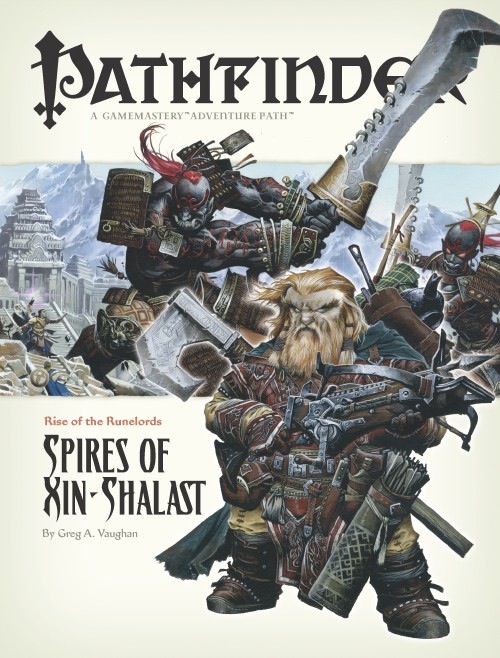
I’m going to break format here as much of this adventure is relatively non-linear. At this point in the campaign, players have a good idea of the threat they’re facing, and have delved into both Thassilonian ruins as well as the time displaced halls of Runeforge. In this crescendo for the adventure path they journey far to the north of Varisia into the Kodar Mountains to the fabled lost city of Xin-Shalast, where they will face the Runelord Karzoug and his awakening minions. This adventure also marks a return of horror influences to the campaign, this time with an undercurrent of cosmic horror, incorporating elements of HP Lovecraft’s Dreamquest tales in the thin places around Mhar Massif.
The players now have a good idea of the threat that Karzoug poses and the tools they need to fight him, but in order to face and neutralize his threat they’ll need to find his capital. In order to do so they venture into the general area of Xin-Shalast, chasing rumors of an expedition led by Silas and Karivek Vekker, a pair of Dwarven prospectors rumored to have found the lost city years before. Following the brothers trail the party is able to find a base they constructed in Kodars. But before they can determine a route to the lost city they have to contend with the aftermath of the expedition, which ended in murder and cannibalism, leaving the miners camp haunted and stalked by a transformed Karivek.
I’m conflicted about this section of the adventure. It technically advances the plot, but isn’t tied to overarching struggle with Karzoug, or even Thassilon other than that the brothers found Xin-Shalast. At the same time it’s a really eerie and interesting adventure in its own right, and marks a very effective return of the haunt system used in Foxglove Manor. I think if I were running this campaign I would either shorten or skip this chapter, but it’s also something I could see myself running by itself, as it’s a very effective haunted wilderness adventure.
From the Vekker’s mining camp the players are able to blaze a route to Xin-Shalast. This includes an encounter that is modified if players helped bring Myriana and Lamatar’s spirits to rest, receiving aid from another fae who guides them through high frozen tundra to the lost cities gates. Without her help this is still possible but much more boring. Even if the players didn’t help Svevenka’s cousin I’d include the encounter and let players bargain for her help.
Entering Xin-Shalast, the players discover a ruined city covered in gold and precious gems, crawling with the minions of Karzoug. Xin-Shalast itself throngs with hostile giants, lamia, and other creatures, and navigating it is a challenge in its own right. As written the adventure doesn’t present a specific (or even recommended) order in which players should explore the city, making this section of the adventure closer to a sandbox than a traditional crawl. In order to enter the occlusion field surrounding Mhar Massif the party needs to secure Sihedron Rings from the vampiric Hidden Beast, the ice devil Gamigin, and the blue dragon Ghlorofaex. Between these Sihedron rings and Sihedron Medallions players retrieved earlier in the campaign they should have enough sources of protection to enter the occlusion field. This is a double edged sword however as Sihedron Rings and Medallions allow Karzoug to track the party and increase the chances of random encounters.
The Hidden Beast is the most interesting of the ring bearers, tied into a side quest where the party is asked to free a hidden society of skulks from the beast’s influnece. The Beast itself is also a classically silly dungeon monster, a powerful sorcerer that is also a ten tentacled vampiric aberration, called to the city in the dying days of Thassilon before being sealed away, only to be inadvertently released by the skulks. The Ice Devil and Blue Dragon are more traditional foes, but are formidable opponents that should make for a challenging fight while exploring the city. Other standout encounters in Xin-Shalast are contacts with a rebel ogre mage who seeks an alliance with players in order to lead an escape attempt by the many enslaved giants in the city, as well as the Abominable Dome, an greenhouse-like dome infested by Yetis.
My biggest complaint about Xin-Shalast is that there are several locations that would make interesting areas to explore but that receive only a brief overview, with it left to a GM to map out and create encounters for them. The most frustrating of these is the Heptaric Locus, since it is the lair of Gamigin. which is described as a maze of trapped tunnels infested with creatures attracted by the old gladiatorial arena’s centuries of violence, but only the devils lair itself is mapped out. Given the ways that Runeforge was expanded in this anniversary edition, I’m surprised that something similar wasn’t done here. Overall that’s a trend for Xin-Shalast, as the nonlinear nature of this section means that much of the city remains a sketch left for a GM to fully flesh out. I wouldn’t be opposed to this if this were a setting book, but I’ve always felt that part of the point of published adventures is to do this kind of work for a GM, so it’s always a bit frustrating to see. With that said, Xin-Shalast as written is a really interesting location, with compelling dynamics between its inhabitants, and even opportunities for players to find allies among them.
Even after securing Sihedron Rings the ascent to the Pinnacle of Avarice isn’t easy, the module as written encourages GMs to make use of altitude and temperature rules, and the climb to the Pinnacle heads straight into the death zone. Players likewise face attacks from Leng spiders and giants, as well as flying enemies if they are spoted from the city below. Alternatively players can make use of a hidden passage concealed in a shop in Xin-Shalast, but even this features a fight with a gargantuan roper. Either way ascending the mountain brings the party to Karzoug’s sanctum: The Pinnacle of Avarice. Players can enter this spire through either a winding ramp to its front door, or via the opening carved by Mokmurian when he entered the tower, which is a nice touch.
However they enter the Pinnacle of Avarice, players are now in the home stretch. Navigating through the Pinnacle will bring the player into position to finally foil Karzoug’s reawakening, and may let them recruit some final allies in the process as well. The section is the highlight of the adventure for me. At this point in the campaign players have explored a wide variety of Thassilonian ruins, many of which were devoted to Karzoug, but the Pinnacle of Avarice feels special, not only is is the Runelord’s inner sanctum, but it is by far the most intact Thassilonian site in the campaign and does even more than Runeforge to show off the strange sin infused artifice of the lost empire. The Leng Device really brings this home for me, showing the ways in which Karzoug took advantage of his capital’s proximity to the strange dimension of Leng to sate his greed and ambition with the riches from a place far more strange and otherworldly than Pathfinders usual planes. The Leng Device also adds yet another dimension to the fight against Karzoug since the Soul Lens now poses a threat beyond unleashing the Runelord.
The Pinnacle has more than extra-dimensional horrors on offer. Karzoug can manifest through various statues in the pinnacle and fighting these intrusions can actually help players in their final battle against the Runelord, since striking down his manifestations with a Dominant weapons weaken him. In addition to the denizens of Leng and the intruding will of Karzoug, players must contend with Giants, summoned creatures and Karzoug’s final lieutenants. Of the latter I find Viorian to be the most interesting. I’ve always found intelligent magic items to be compelling and I think their potential to overcome and puppet their wielders should be used more. Including a warrior essentially enthralled to one of the Seven Swords of Sin is yet another chance for players to grapple with the long legacy of Thassilon and is just cool to boot. And while Viorian can easily just function as a mini boss, I like that the designers explicitly point out ways for players to free her from Chellan’s influence. Khalib and Ceoptra are interesting in their own right, but mostly as examples of the kind of people who serve Karzoug and who were produced by ancient Thassilon. Both are challenging fights but they don’t have as much impact for me, other than showing a bit of how Karzoug has been able to marshal his forces while still trapped in the Eye of Avarice, and bringing a conclusion to the succession of Lamia that the party has been fighting against for most of the campaign. Among the various summoned creatures in the Pinnacle is another potential ally, a bound planetar angel whose fight is more of a puzzle, and who telegraphs to the party how they might be freed.
By breaking the soul lens, the party can enter the Eye of Avarice, a demi-plane constructed by Karzoug where he has been waiting through the long millennia since the fall of Thassilon to be reawakened. This is an extremely challenging fight. Karzoug has absolutely busted stats, made possible through the abuse of magic items and wish (one of the many problems with Pathfinder 1e and 3.5 D&D’s use of PC rules to make NPCs) and he has back up. Still, the players should be 18th level by this point, and if they’ve played their cards right have allies of their own. While they do make the final fight more difficult I appreciate the inclusion of a few giants and a dragon in this fight, since facing a lone wizard, even an extremely powerful one, can get pretty boring.
This chapter of the campaign is supported by a final appendix laying out both what happens should the players fail and potential ways to continue the campaign. Both are great additions to the final adventure of a campaign, both to help provide stakes but also potential follow ups if players want to push on to level 20. I find the the failure state genuinley compelling and they’d be a really interesting starting point for a homebrew campaign. The options for extending the campaign are interesting as well, either clashing with truly legendary creations of Thassilon, or assisting in the further exploration of Xin-Shalast.
Overall I like this adventure a lot, it brings Rise of the Runelords to a close in a suitably epic fashion, and in a really intriguing location. My main criticism is that I wish Xin-Shalast itself had been fleshed out more, since as published a GM is required to do a lot to make it a more discreet location rather than a series of vignettes. I’ll have more thoughts on the campaign as a whole in a separate post, but as a finale adventure this does a lot right, and even its missteps are forgivable given the scale of the adventure thus far.
Discover more from Too Many Thoughts
Subscribe to get the latest posts sent to your email.

 Too Many Thoughts
Rise of the Runelords is such an strange adventure for me, most people that talk about it online have nothing but praises for it but I found it pretty disconnected and full of padding and convoluted plots. It’s a shame because it has the foundations of a great classic adventure and the first 2 books are fantastic but around book 3 it just becomes a slog of fight after fight. Maybe I’m more accustomed to the more modern adventure design of Paizo. What would you say makes this adventure so loved other than nostalgia?
LikeLike