
If you’re even casually interested in SFF you’re probably aware of Dungeon Crawler Carl. Since the first book was released by author Matt Diniman in 2020 the series has become incredibly popular, especially as audiobooks, making them hard to miss in the bestseller section of many marketplaces. This stepped up further in 2024 with the release of the series in hardcover by Ace, and various installments of the series have been riding the bestseller charts ever since. If you have somehow missed it (if so I envy you just a bit) the series follows Carl, a coast guard veteran who is forced to compete in an elaborate bloodsport/reality TV competition/video game after an alien corporation destroys Earth. He’s aided in his attempts to survive the world dungeon by his ex-girlfriends cat, Princess Donut, and a motley crew of other survivors also competing in the crawl. Think Hitchhiker’s Guide to the Galaxy, meets Phillip Jose Farmer’s Dungeon, meets a professional MMO stream.
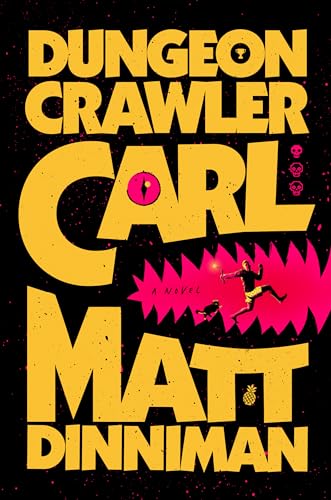
When I initially saw the first few books on Audible, their cover art looked cheap and mostly blended in with the mountains of progression slop that infests any storefront open to self published works. Based purely on that I didn’t have any initial interest in it, but kept seeing the books rising on bestseller charts and began to see more and more positive reviews of them.
Based on those positive reviews I’ve tried to read Dungeon Crawler Carl two times before this attempt, first when it was breaking out on audible and then again when the Ace editions came out. In both of those cases I had a really negative reaction to the opening few chapters and stopped reading. But those positive reviews have continued, and I regularly see patrons looking for the books or something like them at my day job. After Dungeon Crawler Carl was shortlisted for an Arthur C Clarke award, and I saw yet another spike of library patrons asking about it, I decided that I needed to try to read the first book again, if for no other reason than I had to be able to talk to patrons about it. I wasn’t thrilled about this and it wouldn’t be wrong to say that this review halfway started as a hate read.
Unsurprisingly from my earlier experience with Dungeon Crawler Carl and my starting attitude I did not have a good time starting this book. When talking about my experience with friends or online I’ve called the experience miserable. When I started drafting notes for a review the intention was to really rip into it, in part because I was having such a bad time. Then, after I got past roughly the halfway point things started to shift. There was still a lot that I didn’t like, but there was enough that was interesting that I kept going. It worked well enough that I half-resentfully read through to book three of the series. So while there will be some straightforward review elements of Dungeon Crawler Carl (specifically the eponymous first book since it’s the one I had the most trouble with) this will be more of an exploration of why I had such a negative initial reaction to this series, and what changed that.
a review, of sorts
Dungeon Crawler Carl is fine. It’s a pulpy popcorn read that’s decently entertaining once it gets going. It’s still a book with a lot of weaknesses, and if you’re looking for something with some depth, probably give it a pass.
I’ll get two initial gripes I have with it out of the way early because they are entirely subjective. The first is that I don’t like gamelit/litRPG. I understand what is appealing about it for folks, but having explicit game mechanics in a story just takes me out of things. I was eventually able to push past this, but it bugged me in a way that most crunchy power systems don’t. The second is that I didn’t find it to be particularly funny. If I’m being honest this was the larger of these two hurdles, considering so much of the buzz around the series focuses on that humor, but while the situations Carl deals with are ridiculous, the sense of humor here is juvenile and random in a way that felt of a piece with a mid-2000s gaming webcomic and most of the jokes didn’t really land for me.
Dungeon Crawler Carl is also written very simply, I almost always felt like I was reading a YA novel. To be clear there’s nothing specifically wrong with that, a lot of books I love or least have enjoyed are written simply and this includes books explicitly aimed at children. It’s still a bit frustrating for me when a book theoretically aimed at adults is written so simply, but that is not a problem unique to Dungeon Crawler Carl. The bigger issue with Dungeon Crawler Carl is that Dinniman’s prose is not only simple, it is also boring. Nothing is shown that is not immediately told, plot points and character beats are repeated constantly, and if a description can be elided in favor of a pop culture analogy it will be. The prose is functional, but it’s not interesting, and with a premise this crazy that’s really disappointing. The writing quality improves somewhat as the novel goes on, and improves further in later entries in the series. This along with the repetitiveness strikes me as a relic of serialization and I think it’s something that could have been cleaned up more, as the combination makes the novel feel very second drafty.
I also found the character writing in Dungeon Crawler Carl to be pretty lacking, something that doesn’t really improve much in book two or three. I never felt like I had a good understanding of who Carl is as a person, or what drives him. My only real impression after three books is that he’s a fairly generic action hero who wants to survive and help people if he can. And there’s nothing wrong with that exactly, but especially when a story is first person I personally expect to have more of a window into who a character is and why they do what they do. There are hints of a tragic backstory, but they aren’t explored in depth, which is a shame because I think they could do a lot to show the reasons behind Carl’s actions and provide more of a window into how he became the person that we see. This lack of interiority extends to emotions as well. Carl isn’t completely unemotional, but his emotions are given very little attention in the narrative. I think this may be a character choice, but it’s not one that particularly works for me without a more clear idea of who Carl is. It could also just be that Matt Diniman isn’t particularly interested in the emotional or character aspects of this story, but for me it loses a lot by not having those elements more clearly drawn. This extends to other characters as well, though in some cases they have specific traits that are hit repeatedly. This isn’t to say that these other characters are bad, Princess Donut is a redeeming feature of these books for me, but that these characters lack depth.
It’s not all bad though. After all, Dungeon Crawler Carl had enough that interested me that despite my reservations I’ve read several other books in the series since finishing it. Ironically one of the biggest reasons for that is related to one of my complaints. The simple, bland prose means that Dungeon Crawler Carl is a quick, easy read. At the start I called this a popcorn read and I think that’s a good comparison. Popcorn isn’t filling but it tastes fine, and in the same way I didn’t find Dungeon Crawler Carl to be particularly satisfying, but it was entertaining and very easy to consume. To extend the metaphor further, I feel like The Dungeon Anarchists Cookbook graduates to kettle corn, still fairly empty, but with some more interesting flavors. This varies a bit from book to book, but especially the later entries of the series feel like they have some real substance to them, both thematically and stylistically.
The other thing that kept me reading is sadly more of a background element, but I really enjoyed the background politicking that is clearly taking place around the crawl. The space politics and double dealing among those trying to make money from the crawl was fascinating, and I would read something taking that starting point and focusing on it to a greater degree in a heartbeat. My understanding is that this becomes more pronounced as the series goes on, but I feel like as of The Gate of the Feral Gods the forest of interstellar politics is being lost in the trees of the crawl itself. I’m equally interested in the glimpses we see of the Crawl as a show, and find that framing to be a lot more interesting than the crawl as a game. The use of terminology used by reality TV shows and the fact that we see certain crawlers clearly getting hero or villain edits is a great touch. I know of a few books with similar framing (The Franchise by Thomas Elrod and The Acts of Caine series by Matthew Woodring Stover) and I think I need to put both near the top of my TBR.
but how does that make you feel?
Okay. So I thought these books were fine. I have my nitpicks (large and small), but why did I have such a dramatically negative reaction to these books? I think it comes from two places. The first is something I already set aside in the above review, but I do think it’s worth repeating/ LitRPG isn’t my thing, so it was always going to have an uphill climb. Plus, nothing has made me feel my age than the millennialcore sense of humor of these books, something that I think dates this series pretty severely. The second and more serious is that on my initial reads it was almost offensive to me that something as comparatively shoddy as Dungeon Crawler Carl had taken off to such a huge degree, when we’re living in a time when work in the SFF genre is reaching new heights of quality, and where authors of literary talent feel like they can produce serious, well written fiction and not feel like they need to shy away from the sci-fi and fantasy label, proving that a story can be entertaining and fun at the same time as it is well crafted.
But here’s the thing, how different is this really? Before Dungeon Crawler Carl started to tear its way up the bestseller charts the biggest phenomena in SFF was (and honestly still is) the explosion of romantasy, powered by the success of The Fourth Wing by Rebecca Yarros and the A Court of Thorns and Roses series by Sara J. Maas. Looking further back Brandon Sanderson is a consistent bestseller, as was his stylistic fore bearer Robert Jordan. None of these are high art, but, despite thinking that the last couple Stormlight Archive installments were massive letdowns, I’ve never had this kind of strong negative reaction to any of them. In any given genre or artform it’s not the artistic masterpieces or solid well told stories that break big. It’s a work with mass appeal. James Patterson is practically a billionaire. NCIS is still on the air. I won’t even try to pretend I’m not immune to this myself, I’ve read dozens of Star Wars, Halo, and D&D novels.
When I actually sat down and made myself read Dungeon Crawler Carl, I was reminded why that is. Books can do amazing things, they can change the way you view the world, change the way you think about language and story structure, make you think deeply about the way you interact with other people. But before all of that, the thing that people turn to stories to do is entertain them. It’s great if a story is clever or well crafted, but all it really needs to be is entertaining. To bring things back to popcorn, you probably shouldn’t only eat popcorn, but that doesn’t mean you’re wrong for eating it or that I should be upset that it exists. They aren’t great books, but they are entertaining, and sometimes that all a book needs to be.
Discover more from Too Many Thoughts
Subscribe to get the latest posts sent to your email.


